LOOKING FOR RICHARD
UNITÉ D'HABITATION, MARSEILLE, INTERVIEW
OCTOBER 2025
In October 2025, the Gallery Kolektiv Cité Radieuse in Marseille hosted a retrospective of Richard England's work. Looking for Richard was a small-scale, multi-media showcase of the architect's six-decade career – one defined by legitimate and early international attention, and resolutely protective of its author's vision. That vision was shaped in tandem with nascent political changes on the island of Malta, whose independence synced with England's earliest phase of work – his early twenties, where he received his first commission and launched a vocational journey that would have an irretractable imprint on the nation, despite best efforts.
The Gallery Kolektiv spans two rooms on the third floor of the 1952 Modernist behemoth known as the Unité d'Habitation. The building was revolutionary for its time, not just for its béton brut build, but for its structural system – it stacked duplex apartments into an unrelenting concrete frame, containing in total 330 apartments of 23 different types. Its rooftop terrace is iconically etched into people's minds as a concrete playground of form and folly – oscillating between linear, boxy forms and sculptural towers and mounds. Seating made from the same concrete it seemingly emerges out of. Floors speckled coloured off-cuts. And colour – colour systematically deployed throughout the giant block as a morse code for identity.
In an apartment close the gallery, a recorded interview touched on the bearing of Le Corbusier and Modernism on England's own architectural journey; the impact of England's particular counter-narrative; the plight of universality; and the spirit needed to subsist as an architect today.
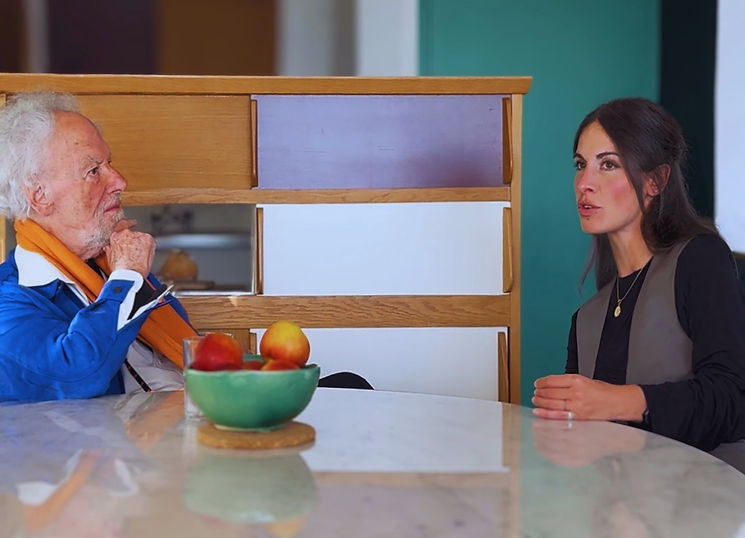
Prof Richard England & Ann Dingli
Unité d'habitation, Marseille, October 2025
AD: I want to start with the building we are in – how does it feel to have an exhibition in one of Le Corbusier's most significant projects?
RE: Humbling. My generation grew up when the Corbusier was at the height of his career, this building was completed in 1952, and I was at university later in the 50s. This building was iconic and his books we were running around everywhere – we kept Modulor in our pockets, as it was small. So yes, one is humbled.
AD: The interesting thing is, as you say, generational difference – when I was growing up Le Corbusier was an almost mythical figure. Someone quoted visually and verbally over and over as a disembodied giant from the past. But he was still working and alive when you were studying.
RE: And when was beginning to do my own work.
AD: I want to discuss that cohort of influence, because Modernism is a prickly one. The famous ‘ornament is crime’ adage – your work actually challenges that.
RE: Yes, in fact I've always difficulties with it. Whenever my work was published, there was usually a sting at the end; because it was, in a way, alienating the modernist theory. The modernist theory goes back to its origin in the Bauhaus, where Walter Gropius had said, “modern architecture is a new tree”. He talked about how we must destroy all the old trees and build something completely new. And my contention was – why a new tree? Why not a new branch? Or a new leaf? So there is a sense of continuity within change. I'm very interested in music, and so I'll pick a quote from Béla Bartók who said: “what is new and significant must, of necessity, be grafted to old roots”. We, ourselves as human beings, are a thread of continuity. So it's extremely difficult to suddenly say modern architecture must eliminate all the past.
AD: Let’s talk about the word commodification. You often describe architecture as a sensorial experience – the idea of a building moving a person beyond expression. But essentially, that is still a condition that's created by an architect, informed by his or her relationship with the elements, how they understand them, and how they can manipulate them. A lot of your own work is curation of nature and the elements – but that's not something written in any client’s brief. No one gives you a brief to create a cosmologically transporting building.
RE: No, nor to elevate the soul or to enhance the spirit. They will give you a brief either for accommodation, or simply to make money. Because this is the tragedy now, that architecture has become a tool for money making. And so this is why I'm particularly interested in the architecture of the Ancients, especially the Neolithic culture of Malta. Because this was a group of people who thought about architecture through the lens of nature and the movement of the stars. They had discovered that the earth could be made fertile, and began to understand that the movements of nature dictated when they should sow. They had to work on the terms of, and in relation to, the cycles of nature. That was an era when the land had more meaning. Now we've lost that.
AD: How and what is the impetus for architects today to create a relationship between architecture and nature. Ergo, how can we move past commodification?
RE: Let’s go back to Malta. The thing now which is happening is that a few young architects are doing wonderful little houses – because in that context, again, the client is actually looking for a place where the family lives in harmony. That is about the last bit of hope there is for trying to revive architecture on the islands.
AD: Well, that's the provocation I have for you. What instruction would you give to a young architect today – one who might also feel as though architecture is only now about commodification, stripped out of any inroad to innovation, playfulness, or sense of awe?
RE: I used to give my students a task to design a room in which you feel uncomfortable. Why? Because once you learn how to make a room which is uncomfortable, you can then possibly try and make a room in which you feel comfortable. And one of the things I've always tried is to follow is what CS Lewis said, that “while others were building ships in their bottles, I was building a lighthouse”. I still do a lot of reading, because I always believe that, in the end, you need to learn and to keep learning. One of my favorite authors is Borges – one of the most extraordinary people – and he said, “my business is to weave dreams”. I remember watching a television programme a long time ago when he was still alive on Rai – he was being interviewed – and he was blind at the time, completely blind. The interviewer said: “let me ask you what might be a very uncomfortable question; you're blind, why do you still travel so much?” And Borges said, “because it's more important to feel a place than to see it”. And that's exactly what we were talking about.
But that's what we've lost. Because now the other thing aside from money is a sense of perverse, I was about to say ‘innovation’, but that’s not it. I mean, you've now got to make buildings that are warped.
AD: That attract attention.
RE: Yes. And the difficulty is that architecture has become a brand. Certain countries want a building from a specific architect. Buildings have been commodified, yes, exactly. So I don't know what the answer is. I don't know if we will ever know.
AD: I think the answer is here today, in this in this building. Which is that no matter what we do, no matter how we try to dress up agendas and manipulate space to their ends, the universal things that touch human beings are not going to change. Light, air, space, proportion. Feelings of being secure and protected but also being in awe of something.
RE: Features that makes us human.
AD: So when people look at your work – as they will in this exhibition – there needs to be an understanding of how your compositional strength, your use of light and shadow and colour, all of it was in pursuit of harnessing those universal traits.
RE: It's about how to create a timeless architecture, which is case in point the building we’re in. This building is around 75 years old.
AD: And not built for the rich.
RE: On the contrary. So what about air? What about proportion? Those things are not included anymore. Get them back. I remember walking into Louis Kahn's building at Yale (the British Centre for Art) and thinking – we can still do it. The way he blends wood, marble, concrete. It's a poem. It's a visual poem. and that's what we should be thinking of. It's also about creating ‘space’ in architecture – it's about silence. In a way, music, for example, is more about the silence between the notes than the notes themselves. Because, in fact, I don't know if Luis Barragán's chapel (Chapel of the Capuchinas Sacramentarias), for example – which is absolute minimalism – works more emotionally than perhaps it does functionally, which is also what a lot of people say about my architecture.
AD: There are different types of functioning.
RE: Yes, exactly. Because space is manipulative; the geography of the space influences the geography of the body – and that is far more important. You know, I've always said that architecture is not a profession, it's a vocation. Because in the end, the onus of the work of an architect is to create the environment within which we exist. How can we produce an architecture which makes us feel better? That's it. It's as simple as that. How can you create a space in which, one feels: this is beauty.